Chasing Losses, Shillong Teer Result
How chasing losses works for shillong teer result, UPI details, realistic timings and the pitfalls to avoid.
What is Chasing Losses?
Chasing losses is the behaviour of placing larger or more frequent bets on Shillong Teer result rounds specifically to recover money lost in previous rounds. Instead of accepting a loss and stepping back, a player doubles down, driven by the belief that a win is "due" or that one big hit will wipe the slate clean. In the context of Teer, chasing typically looks like this: a player bets ₹100 on a First Round number, it misses, so they immediately stake ₹200 on the Second Round to "get it back." When the Second Round also fails, they resolve to bet ₹500 the next morning.
Each cycle pulls them deeper into a pattern that feels logical in the moment but compounds risk with every step.
What makes Teer particularly prone to this pattern is its two-round daily structure. The short gap between the First Round (approximately 3:45 PM) and Second Round (approximately 4:45 PM) creates a natural emotional window, the sting of a loss is fresh, the next draw is minutes away, and impulsive recovery bets feel low-stakes even when they are not. Compare this to a weekly lottery such as Kerala Lottery or Sikkim State Lottery, where a seven-day gap between draws forces a natural cooling-off period. Teer's daily, twice-a-day cadence removes that buffer entirely, making chasing both easier to fall into and harder to interrupt once it begins.
Many players in Shillong and across Meghalaya fund their Teer bets through small UPI transfers, sending ₹50 or ₹100 to a counter agent via PhonePe, Google Pay (GPay), or BHIM before heading to the physical counter. This frictionless payment flow makes it especially easy to add "one more" transfer after a loss, because there is no physical cash to count out. The money leaves your PhonePe balance instantly and silently, which removes one of the natural pause points that handling physical notes would otherwise create.
Players who exclusively use UPI to pay counter agents report spending meaningfully more per session than those who use cash, simply because the act of transferring feels less real than handing over notes at a Police Bazar or Polo Ground counter.
Why it feels rational but isn't
Three cognitive traps keep chasing feeling justified even as losses mount. First, the Gambler's Fallacy: Teer numbers are not "owed" to you, yesterday's miss has zero influence on today's Shillong Teer result because the archers shoot fresh every afternoon and the target has no memory. Second, payout distortion: a ₹1 bet returning ₹80 (First Round) or ₹60 (Second Round) feels enormous, masking the fact that the implied probability of winning is well below those multipliers and the house edge is firmly built in.
Third, sunk-cost pressure: the more you have already lost, the harder it is psychologically to walk away, even when walking away is the statistically correct decision. A ₹300 loss feels like unfinished business; a fresh ₹300 recovery bet feels like the solution rather than an extension of the problem.
Chasing Losses Step by Step
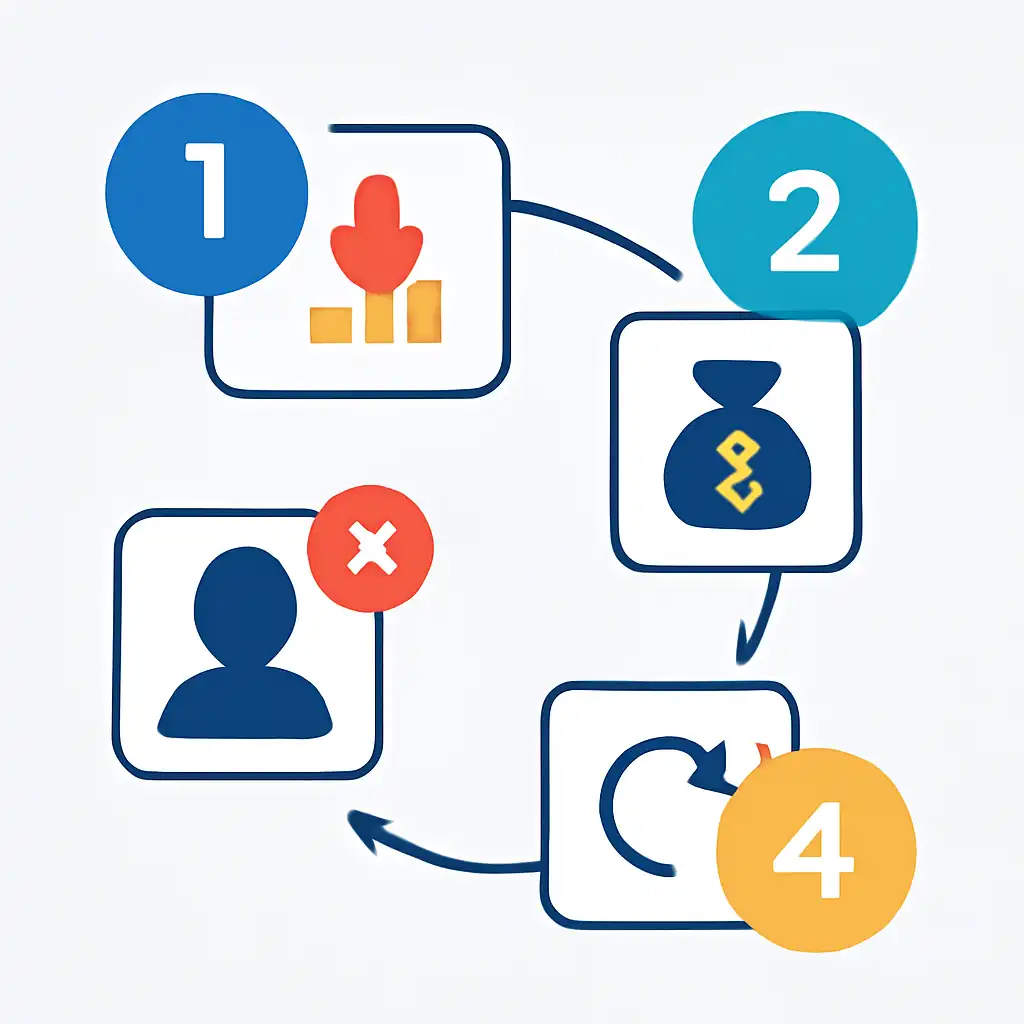
Understanding the exact sequence of how a chasing spiral unfolds at a Teer counter helps you recognise, and interrupt, the pattern before it escalates. The following example uses realistic ₹ amounts that reflect typical counter stakes in Shillong and walks through each decision point where the spiral could be stopped but usually isn't.
-
Step 1, The Trigger Loss
You place a considered bet of ₹50 on number 42 for the First Round, based on a dream number or a teer common number forecast circulating in a WhatsApp group. The First Round result is announced at around 3:45 PM: 67. Your ticket is worthless. This is a normal, statistically expected outcome, the loss itself is not chasing. You are down ₹50 and that is a complete, closed event. The session is over if you choose to let it be.
-
Step 2, The Recovery Decision
With roughly 60 minutes until the Second Round, you decide to "fix" the loss. You increase your stake, commonly 2× to 5× the original amount, and pick a new number, sometimes switching strategy mid-stream. You abandon your dream number in favour of a "hit number" shared on a Teer Facebook group or Telegram channel and stake ₹150 on number 56 for the Second Round. This is the exact moment chasing begins: the bet size was chosen to recover ₹50, not because ₹150 on number 56 was your considered plan when you woke up that morning.
-
Step 3, Stake Escalation
The Second Round result comes in at approximately 4:45 PM: 23. You have missed again. Total outlay is ₹50 + ₹150 = ₹200. The emotional target has now shifted, you need to win back ₹200, which means tomorrow's bet must produce a net profit after covering the deficit. So the planned stake for the following morning climbs to ₹300 or ₹400. The required bet size grows non-linearly with each miss, because both the deficit and the emotional hurdle for what counts as "recovery" keep rising together, compounding faster than most players realise in the moment.
-
Step 4, The Payment Platform Trap
That evening, checking your PhonePe or GPay transaction history reveals the two outgoing transfers, ₹50 and ₹150, listed plainly. Rather than serving as a deterrent, seeing the exact loss amount in a transaction log often sharpens the urge to recover. Some players then transfer tomorrow's planned stake, say ₹400, to the counter agent's UPI ID that same evening to "commit" to the plan before they lose nerve.
Pre-committing via BHIM or PhonePe removes the decision point that might otherwise cause hesitation the next morning. The money is already gone before you have slept on it, and sleep is one of the most reliable circuit-breakers for emotional betting decisions.
-
Step 5, The Next-Day Carry-Over
When the day's rounds close, unrecovered losses carry emotional weight overnight. Many players arrive at the counter the following morning already committed to a large stake before they have even consulted the morning's teer common numbers or properly checked the previous Shillong Teer result list. Decisions are now driven by debt psychology, not analysis. The number selection process, which on a good day involves reviewing previous results, checking dream number charts, or comparing hit number archives, is compressed or skipped entirely because the emotional urgency to bet has overridden any analytical habit.
-
Step 6, Rationalisation Loop
Each miss is reframed as "almost" or "bad luck" rather than as normal statistical variance. Players begin citing hit streaks, pointing to previous result lists as evidence that a specific number is "overdue." For example: "Number 42 has not appeared in 18 days, it must hit soon." This is the Gambler's Fallacy in action, and it keeps the spiral anchored in place by providing a narrative reason to keep betting rather than a strategic one. The result archives that should be used as a calm pre-session research tool are now being weaponised to justify accelerating losses.
-
Step 7, Hard Stop or Blowout
The spiral ends in one of two ways: a forced stop (daily budget exhausted, borrowing required from a friend or family member, or a deliberate decision to exit the pattern) or a lucky win that temporarily validates the entire behaviour and resets the cycle to Step 1. Wins at this stage are especially dangerous, they produce strong confirmation that chasing works, which means the next spiral begins from a higher baseline stake and with less psychological resistance to escalation.
Pattern-breaking checkpoints
The most reliable interruption points in the chasing cycle are Step 2 and Step 4, the recovery decision and the evening pre-commitment transfer. At Step 2, the practical rule is simple: if the First Round has already closed and you were not already planning a Second Round bet before the result was announced, do not place one now. Pre-decide your Second Round stake in the morning alongside your First Round stake, or not at all. Reactive Second Round bets placed specifically because the First Round missed are almost always chasing bets by definition.
At Step 4, the PhonePe or GPay evening transfer is the single most destructive enabling behaviour. A concrete counter-measure is to delete the counter agent's UPI ID from your saved contacts after placing your daily bets, so that any evening transfer requires you to manually re-enter the VPA, a small friction that is often enough to pause and reconsider. Alternatively, use GPay's per-recipient spending limit feature to set a hard daily cap on transfers to that UPI ID, capping exposure at your pre-decided daily budget rather than your post-loss emotional budget.
Chasing Losses Common Questions
- Is chasing losses illegal in Teer?
- No, placing multiple bets across rounds or on consecutive days is entirely legal within licensed Teer counters in Meghalaya operating under the Meghalaya Amusement and Betting Tax Act. Chasing is a behavioural risk, not a legal one. Licensed counters do enforce per-ticket stake limits (typically ₹100 maximum per number per counter per round), which naturally cap a single-bet exposure even if they do not cap overall daily spend across multiple counters or numbers.
- Can studying the Shillong Teer result history help me recover losses faster?
- Historical Shillong Teer result data, previous results lists, hit number archives, common number charts, can inform number selection as part of a consistent pre-bet research process. What they cannot do is tell you that a specific number is overdue or guaranteed to appear soon. Teer is determined by the physical count of arrows hitting a target; it is not a number sequence with a mathematical pattern that resets or balances over time. Using history to chase is specifically counterproductive: it adds a layer of false confidence on top of an already-emotional decision.
- What is the difference between chasing and increasing stake size sensibly?
- The distinction lies entirely in motivation and timing. A planned, rules-based stake increase, for example, raising your base stake by 10% after four consecutive net-positive weeks, is a strategy decision made in a calm state. An unplanned stake increase made specifically because you lost the previous round is chasing, even if the rupee amount is small. The clearest diagnostic question: Would I be placing this bet at this stake size if I had not lost yesterday? If the answer is no, the bet is chasing regardless of how it is rationalised.
- Do Teer common numbers or dream number charts reduce the risk of chasing?
- They do not reduce statistical risk, but used correctly they can reduce the impulsive decision-making that fuels chasing. Having a number pre-selected, committed to before you check the previous round's outcome, removes the emotional number-switching that typically accompanies recovery bets. Use common number resources and dream number charts as a pre-session input the night before or first thing in the morning, not as a post-loss pivot tool at 4 PM when emotions are running high and the Second Round counter is still open.
- If I use PhonePe or GPay to pay the counter agent, does that make chasing worse?
- Yes, for most people. UPI payments via PhonePe, GPay, or BHIM remove physical friction from betting. Counting out ₹300 in notes takes a few seconds and makes the amount feel real; tapping a UPI transfer takes three seconds and feels abstract. Setting a daily UPI spending limit specifically tied to Teer counter UPI IDs, available in PhonePe under payment controls or in GPay's per-contact limits, is a practical structural guard against impulse chasing transfers made in the heat of a losing session.
- Is there a safe way to "chase" in Teer?
- No recovery strategy eliminates variance in a game of chance, and no staking system (Martingale, Fibonacci, flat-betting) changes the underlying odds. The closest thing to a controlled approach is a hard daily loss-limit rule set before you place your first ticket: if losses on a given day exceed a pre-decided ₹ amount, you do not bet again until the following morning, and tomorrow's stake returns to your base amount regardless of how large the accumulated deficit has grown. This limits damage without creating the illusion of mathematical recovery that does not exist in practice.