UPI Deposits, Shillong Teer Result
A practical guide to upi deposits for shillong teer result: the steps, the limits and the common mistakes.
What is UPI Deposits?
UPI (Unified Payments Interface) deposits are real-time bank transfers you make directly into your Shillong Teer betting account using apps such as PhonePe, Google Pay, Paytm, BHIM, or your bank's own UPI application. The National Payments Corporation of India (NPCI) manages the UPI rail, so every transfer is governed by RBI-regulated infrastructure rather than a third-party wallet. As of 2024, UPI processes over 14 billion transactions per month across India, making it by far the most widely used instant payment method in the country, and the default deposit method on virtually every Shillong Teer online platform that accepts digital payments.
On Shillong Teer platforms, a UPI deposit converts your bank balance into account credits you can immediately use to place numbers on the First Round (3:45 PM IST) or Second Round (4:45 PM IST) arrow counts. Unlike net banking, which can take 2 to 5 minutes to confirm and sometimes requires a separate OTP through your bank's channel, a successful UPI push typically reflects in your teer account within 10 to 30 seconds, well inside the closing window for each round.
Compared to credit or debit card deposits, UPI carries zero surcharge on most teer platforms and requires no card details to be stored anywhere on the site. This matters in the Shillong Teer context because players routinely deposit small amounts (₹50 to ₹500) multiple times per week; even a 1% card surcharge stacks up meaningfully over a monthly teer schedule.
Because Shillong Teer results are declared at fixed daily times by the Khasi Hills Archery Sport Association (KHASA), players must have a funded account before each round closes. UPI is uniquely suited to this time-sensitive pattern: you can top up from a roadside tea stall in Shillong, a shop in Guwahati, or an office in Mumbai using the same 4G-connected phone you check the teer results on, no branch visit, no queued NEFT, no ATM required. This anywhere-anytime funding capability is why UPI has displaced cash-agent intermediaries on most reputable teer platforms since 2021.
- VPA / UPI ID
- A virtual payment address such as
yourname@ybl(PhonePe / Yes Bank),yourname@okaxis(Google Pay / Axis Bank),yourname@oksbi(Google Pay / SBI), oryourname@upi(BHIM) that routes money to the platform's acquiring bank without exposing any account number. - UTR / UPI Reference Number
- A 12-digit Unique Transaction Reference generated by NPCI for every successful transfer. Save this after each deposit, it is the only proof of payment accepted by teer support teams when raising a credit dispute.
- Collect Request
- Some teer sites send a pull request to your UPI app rather than asking you to push funds. You approve it with your UPI PIN. This method is faster but requires your registered UPI ID to match the one on your teer account profile exactly.
- Per-transaction Limit
- NPCI caps a single UPI transaction at ₹1,00,000 for most accounts. Banks such as SBI, HDFC, ICICI, and Axis apply their own sub-limits, often ₹25,000 to ₹50,000 per transaction on standard savings accounts. Most Shillong Teer platforms set their own daily deposit ceiling between ₹10,000 and ₹50,000 depending on account verification tier.
UPI vs other deposit methods at a glance
| Method | Typical credit time | Surcharge | Requires sensitive details on site |
|---|---|---|---|
| UPI (PhonePe / GPay / BHIM) | 10 to 90 seconds | None | No |
| Net banking (IMPS) | 1 to 5 minutes | ₹5 to ₹15 | Yes (bank login) |
| Debit card | 1 to 3 minutes | 0.9% to 1.5% | Yes (card number, CVV) |
| Paytm wallet top-up | Instant (wallet balance) | None | Wallet credentials only |
How UPI Deposits Works
The process has two paths depending on whether the platform uses a push flow (you initiate) or a collect flow (the platform requests). Both are common on Shillong Teer result sites. The push flow is more widely supported across all UPI apps, while the collect flow is faster when your teer account's registered mobile number exactly matches your bank's UPI-linked number. Understanding both flows means you are never caught unable to fund your account in the 15-minute window before a round closes.
Push flow step by step (most common)
- Log in and open the Deposit page: Navigate to your teer account's cashier section before 3:30 PM IST if you want to bet on the First Round, or before 4:30 PM IST for the Second Round. Platforms typically lock the deposit gateway 10 to 15 minutes before each round closes to prevent last-second credit failures from affecting your active bets.
- Select UPI as the payment method: The page displays a platform VPA (e.g.,
shillongteer@axisb) and, on most sites, a scannable QR code. Verify that the VPA domain matches a known bank handle:@ybl(Yes Bank / PhonePe),@oksbi(SBI / Google Pay),@okhdfcbank(HDFC / Google Pay),@axisb(Axis),@ibl(IndusInd). - Enter the amount in your UPI app: Open PhonePe, Google Pay, Paytm, or BHIM, paste or scan the VPA, and type the exact deposit amount. The minimum is usually ₹50; round amounts such as ₹100, ₹200, or ₹500 process fastest because some bank systems flag unusual decimal values for manual review.
- Authenticate with your 6-digit UPI PIN: Your bank authenticates you locally on the device via the UPI app's secure enclave. The PIN never leaves your phone and is never transmitted to either NPCI or the teer platform.
- Copy the UTR and submit: After your UPI app shows "Payment Successful," a 12-digit UTR appears on the confirmation screen. Copy it and paste it into the platform's confirmation field within 5 minutes. This step links your NPCI transaction to your specific teer account; without it, manual credit can take several hours, potentially missing the round you intended to bet on.
- Wait for credit: Automated systems credit within 30 to 90 seconds. Manual-verification platforms can take up to 10 minutes during peak load, typically 3:00 to 4:15 PM IST on busy teer days, especially Saturdays when counter and online volume is highest across Meghalaya.
Collect flow step by step (fastest when available)
- Enter the amount on the platform's deposit page and click Pay Now. The site generates a collect request tied to your registered mobile number.
- NPCI pushes a notification to your UPI app within 5 to 15 seconds. If you have multiple UPI apps installed, the notification typically arrives on the app associated with your primary bank account, usually PhonePe or Google Pay for most Indian users.
- Open the notification, verify the payee VPA and amount displayed, then approve with your UPI PIN. Never approve collect requests you did not personally initiate; fraudulent collect requests targeting teer players are a documented phishing method.
- Credit is automatic and usually instant, no UTR entry required on the platform side because the platform already holds the transaction reference from its own API call to NPCI.
What happens inside the payment network
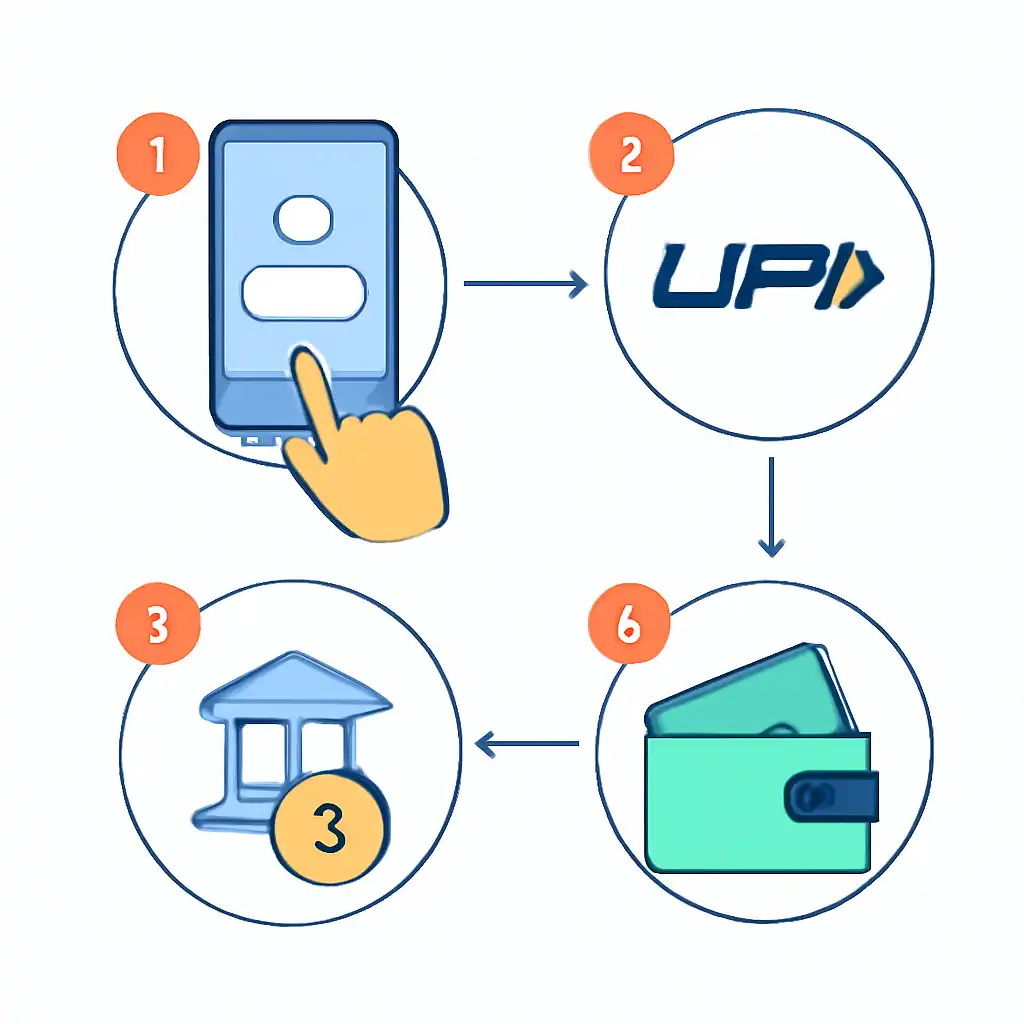
When you approve a UPI transaction, your bank (the payer PSP) sends an encrypted debit request to NPCI. NPCI routes it to the teer platform's acquiring bank (the payee PSP), which credits the merchant account and sends a success webhook back through NPCI to the platform's payment gateway. The entire four-party exchange takes under two seconds on a standard 4G connection in Shillong, Guwahati, or any major Indian city. A delay at any single node, your bank's core system, the NPCI switch, or the acquiring bank's webhook delivery, can cause a lag even when your app already shows "Success." This is why the UTR submission step exists: it lets the platform manually reconcile and credit your account if the webhook is delayed.
Splitting large deposits is sometimes necessary because of bank-level sub-limits. If your Axis Bank savings account caps UPI pushes at ₹25,000 per transaction but you want to deposit ₹40,000, place two separate transactions, ₹25,000 first, wait for credit confirmation, then ₹15,000. Leave a 2 to 3 minute gap between transactions to avoid triggering your bank's automated rate-limiting flag, which can temporarily block further UPI debits and is particularly disruptive 30 minutes before a teer round closes.
UPI Deposits Safety and Timing
UPI operates on a two-factor authentication model mandated by RBI: device binding (your SIM or registered phone number verified at app setup) plus your UPI PIN entered at every transaction. No merchant, including any Shillong Teer platform, ever sees your bank credentials, account number, or PIN. The platform only receives a binary success or failure signal from NPCI along with the 12-digit transaction reference. This architecture makes UPI structurally safer than net banking for teer deposits, where entering your bank login on a third-party site carries direct phishing risk if the site is fraudulent or has been compromised.
Threats specific to the Shillong Teer context
- Fake VPA fraud: Scam sites mimic legitimate teer platforms and display a personal VPA (e.g.,
ramesh123@paytm) instead of a verified business VPA. Always confirm the VPA resolves to a registered business name, PhonePe and Google Pay show the registered name before you approve. - Screen-share social engineering: Fraudsters posing as "teer support agents" ask you to share your screen via AnyDesk or TeamViewer to "verify the deposit." No legitimate teer platform support team ever requests remote screen access. End the call immediately.
- Collect request phishing: You receive an unsolicited UPI collect request for an amount matching a common teer bet, ₹100, ₹200, ₹500. Approving it sends money to the attacker's account. Only approve collect requests after you have clicked "Pay Now" yourself on the official platform.
- Duplicate UTR claims: A UTR number is valid for exactly one transaction and one account. Never share your UTR in public Telegram teer groups; bad actors attempt to claim credit using copied references on different accounts, which can delay your own credit while support investigates.
Practical safety checklist before every deposit
- Verify the payee VPA domain belongs to a known bank handle before approving any payment.
- Never share your UPI PIN or OTP with any platform representative, "agent," or Telegram contact claiming to be teer support.
- Download UPI apps exclusively from the official Google Play Store or Apple App Store. Side-loaded APKs circulating in teer tip channels have been found to contain keyloggers that capture UPI PINs entered during transactions.
- Enable transaction SMS and push notifications from both your bank and your UPI app so you detect any unauthorized debit within seconds rather than hours.
- Set a UPI daily spend limit inside PhonePe, Google Pay, or BHIM equal to your intended weekly teer budget to cap potential loss from any single account compromise event.
Timing windows for Shillong Teer rounds
| Round | Betting closes | Latest safe deposit time | Result declared |
|---|---|---|---|
| First Round | 3:45 PM IST | 3:30 PM IST | ~4:00 PM IST |
| Second Round | 4:45 PM IST | 4:30 PM IST | ~5:00 PM IST |
Deposit at least 15 minutes before each round closes. NPCI schedules two short maintenance windows daily, approximately 00:00 to 00:30 IST and 02:00 to 02:05 IST, during which UPI transactions may be queued rather than processed instantly. These windows do not affect afternoon teer sessions but matter for players topping up their balance late at night ahead of the following day. During peak afternoons (3:00 to 4:30 PM IST on weekdays and all day Saturday), acquiring banks handling high teer platform volumes occasionally throttle incoming webhooks, extending credit time from the usual 30 to 90 seconds to 3 to 5 minutes. Build this buffer into your pre-round routine.
Failed or pending deposits: resolution steps
- Wait 10 minutes from transaction time. Most NPCI auto-reversals for "deemed failed" transactions complete within this window and the funds return to your bank account automatically.
- Check your bank's UPI statement for the UTR status. "Deemed Successful" means NPCI confirmed delivery to the payee bank, contact the teer platform's support with the UTR and a screenshot. "Refund Initiated" means the money returns to your account within T+3 business days under RBI circular RBI/2019-20/142.
- If the platform does not respond within 24 hours and your bank shows "Deemed Successful," raise a formal dispute via your bank's mobile app. SBI YONO, HDFC MobileBanking, and ICICI iMobile all have a UPI Disputes section under Settings → Payments.
- For disputes unresolved beyond 3 business days, escalate to the NPCI BHIM UPI complaint portal at npci.org.in or the RBI Integrated Ombudsman Scheme at cms.rbi.org.in.